
CEOs Overestimate Employee Trust In AI Leadership: BCG Report
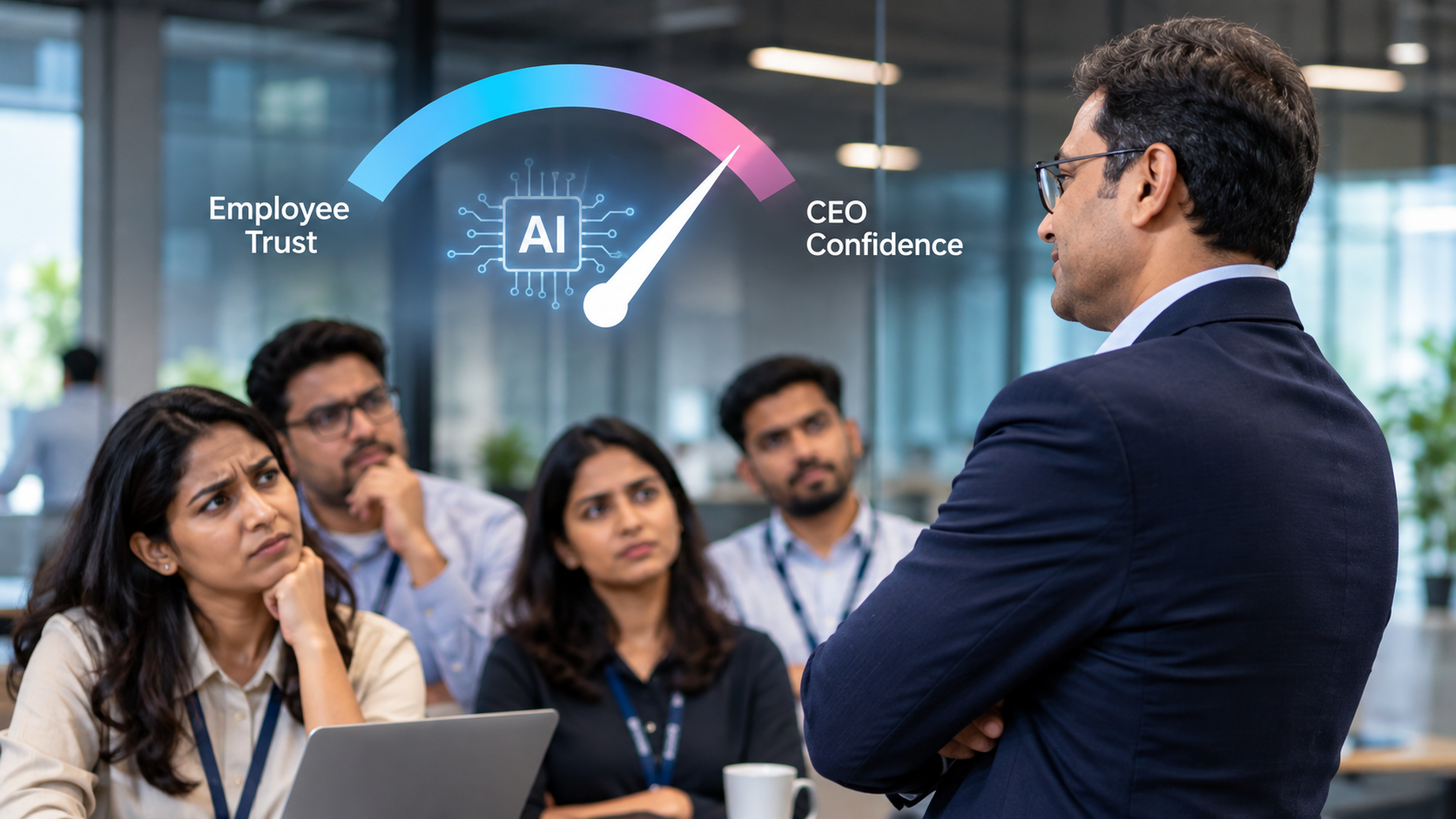
According to the latest BCG report, nearly 90% of CEOs believe their employees trust their leadership, but only 46% of employees resonate.
Nearly 90% of CEOs believe their employees trust their leadership, but only 46% of employees share that confidence. The gap becomes more pronounced when it comes to artificial intelligence (AI), with 40% of employees saying their CEO has not been transparent enough about how AI could affect their roles and career opportunities.
These findings come from the second edition of the BCG CEO Insomnia Index, based on surveys of 645 CEOs and 500 nonexecutive employees. The report highlights a disconnect between how business leaders view their approach to AI-led transformation and how employees experience the changes.
The gap extends to employee well-being. Nearly 70% of CEOs are confident that employees trust them to prioritise their well-being when deciding how to fund critical business priorities. However, only 36% of employees agree that their CEO considers employee well-being alongside business needs when making major workforce decisions.
The findings suggest that employees want greater clarity about how AI will change their work and career prospects. Fewer than 10% give their CEO top marks for explaining AI’s impact on jobs.
Employee trust also appears closely linked to their willingness to contribute beyond their formal responsibilities. Among employees who say their CEO’s leadership and communication on AI have eroded their trust, fewer than 10% are more willing to go above and beyond in their roles than they were three months ago. In contrast, 50% of employees whose trust increased because of their CEO’s approach to AI say they are more willing to make that extra effort.
Despite this, 58% of CEOs say they are not concerned about rising employee disgruntlement. The report notes that many leaders believe they are already doing enough to keep employees satisfied.
The study also identifies a gap in how CEOs assess the risks of AI transformation. Only 15% of CEOs are concerned that their approach to AI could erode employee trust, while employees report concerns about transparency and the potential impact on their jobs.
BCG experts point to communication, employee engagement and training as important parts of building trust during AI adoption. The report notes that employees may fear becoming dispensable if they do not receive adequate training or a clear understanding of how AI will change their roles.
“CEOs are massively underestimating the training needed for their teams to be able to use AI. When you are not trained, you are probably scared because you may feel that you’re becoming useless,” said Neeraj Aggarwal, BCG Vice Chair Asia Pacific Managing Director and Senior Partner.
The report also finds that CEOs are facing competing business pressures. Around 60% say near-term pressures consume a disproportionate share of their time, rising to 68% among leaders of the largest companies surveyed. More than half (54%) often feel pressure to prioritise near-term performance over long-term growth investments.
Meanwhile, 42% of CEOs identify moving too slowly to respond to changing market conditions as their biggest concern.
The BCG CEO Insomnia Index is based on a survey of CEOs from companies with revenue of $100 million or more, conducted between June 18 and July 5, 2026. The employee survey was conducted between June 23 and June 25, 2026.